My current research centers on autonomous vehicles, with a specific focus on trajectory generation and decision‑making in driving scenarios. Additionally, I am exploring related topics such as ODD-awareness and reinforcement learning.
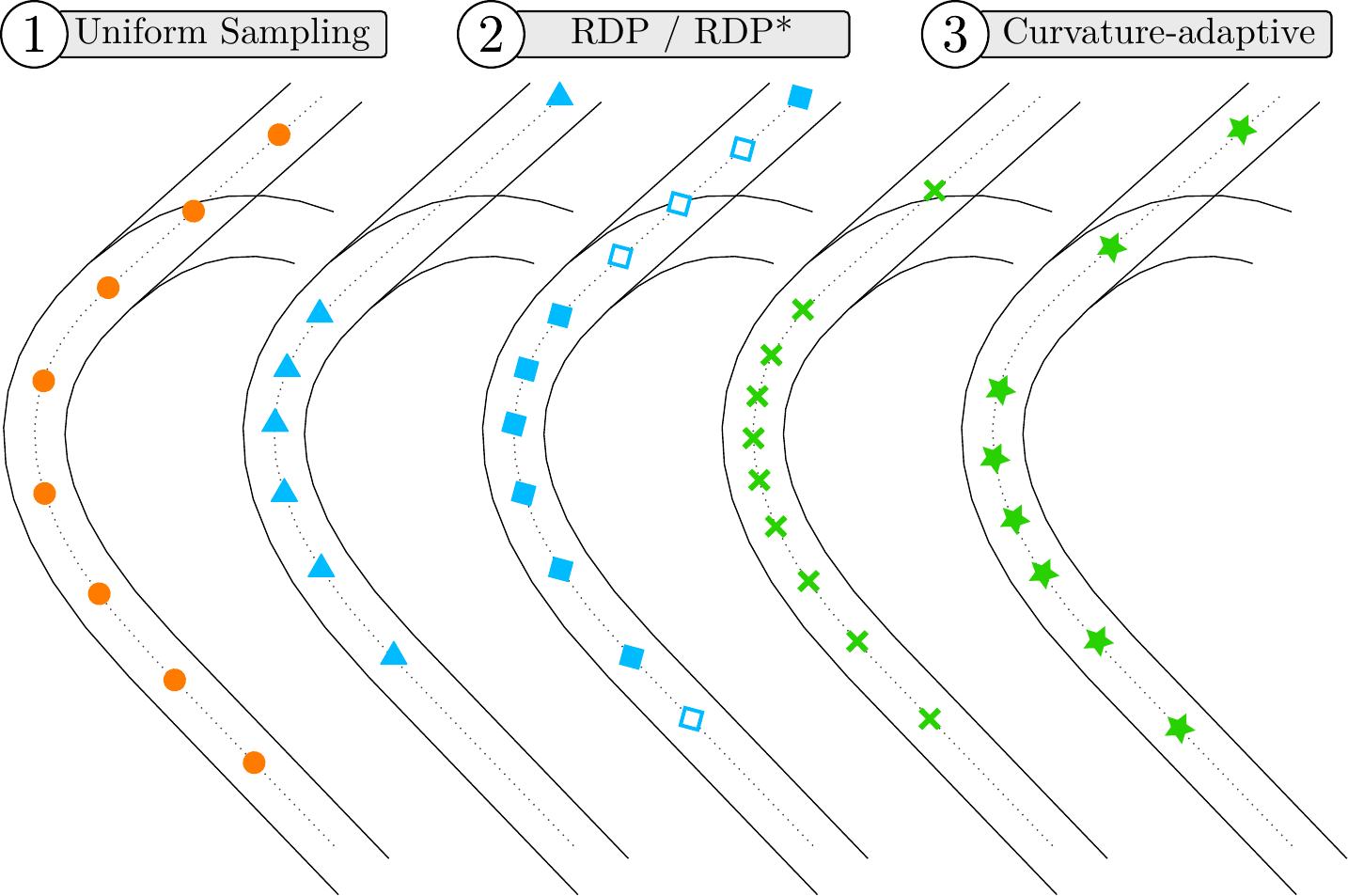
Real-time autonomous driving commonly relies on sampling-based trajectory planners that link candidate trajectories to target waypoints along the road centerline. The placement of these waypoints directly impacts both the existence and quality of feasible trajectories. Yet, its effect on planner performance remains largely unexplored. In this paper, we treat waypoint placement as a first-class design variable. We hold the trajectory primitive and candidate budget fixed, and systematically sweep three placement strategies (uniform spacing, an augmented Ramer-Douglas-Peucker variant (RDP*), and a novel curvature-conditioned allocation) across 449 configurations and five CommonRoad maps of increasing geometric complexity. Our results show that the nominal inter-waypoint spacing d_s is the primary performance driver, with large differences in planner reliability attributed to placement alone. Uniform sampling at a well-tuned spacing matches or surpasses both RDP* and the centered curvature variant. The curvature variant offers a small but consistent advantage on geometrically complex roads under reliability-first and balanced weightings, while RDP* never outperforms uniform sampling. These findings suggest that d_s should be treated as the dominant tuning parameter, with geometry-aware strategies reserved for curvature-rich corridors where feasibility is the limiting factor.
@article{barbera2026waypoints,title={Waypoints Matter: A Systematic Study for Sampling-Based Trajectory Planning},author={Barbera, Josep M. and Artuñedo, Antonio and Villagra, Jorge},year={2026},month=sep,eprint={2606.06366},archiveprefix={arXiv},primaryclass={cs.RO},journal={IEEE ITSC - Naples},}
On the occurrence of buoyancy-induced oscillatory growth instability in directional solidification of alloys
Josep M. Barbera , Thomas Isensee , and Damien Tourret
IOP Conference Series: Materials Science and Engineering, May 2023
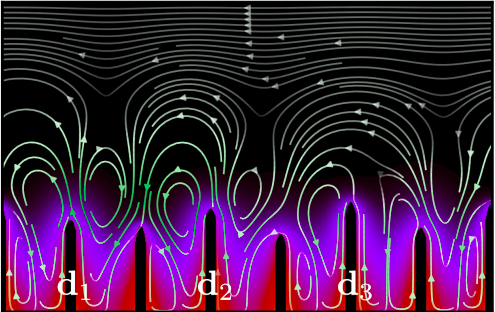
Recent solidification experiments identified an oscillatory growth instability during directional solidification of Ni-based superalloy CMSX4 under a given range of cooling rates. From a modeling perspective, the quantitative simulation of dendritic growth under convective conditions remains challenging, due to the multiple length scales involved. Using the dendritic needle network (DNN) model, coupled with an efficient Navier-Stokes solver, we reproduced the buoyancy-induced growth oscillations observed in CMSX4 directional solidification. These previous results have shown that, for a given alloy and temperature gradient, oscillations occur in a narrow range of cooling rates (or pulling velocity, V p ) and that the selected primary dendrite arm spacing (Λ) plays a crucial role in the activation of the flow leading to oscillations. Here, we show that the oscillatory behavior may be generalized to other binary alloys within an appropriate range of (V p ,Λ) by reproducing it for an Al-4at.%Cu alloy. We perform a mapping of oscillatory states as a function of V p and Λ, and identify the regions of occurrence of different behaviors (e.g., sustained or damped oscillations) and their effect on the oscillation characteristics. Our results suggest a minimum of V p for the occurrence of oscillations and confirm the correlation between the oscillation type (namely: damped, sustained, or noisy) with the ratio of average fluid velocity over V p . We describe the different observed growth regimes and highlight similarities and contrasts with our previous results for a CMSX4 alloy.
@article{barbera2023occurrence,title={On the occurrence of buoyancy-induced oscillatory growth instability in directional solidification of alloys},author={Barbera, Josep M. and Isensee, Thomas and Tourret, Damien},year={2023},month=may,doi={10.1088/1757-899X/1281/1/012050},url={https://dx.doi.org/10.1088/1757-899X/1281/1/012050},publisher={IOP Publishing},volume={1281},number={1},pages={012050},journal={IOP Conference Series: Materials Science and Engineering},}
Feel free to reach out for collaborations, questions, or just a chat!